Problem 12-11 Source:
Problem 49 from the Electrical Circuits I list,
from the UFRGS School
of Engineering, 2011, Prof. Dr. Valner Brusamarello.
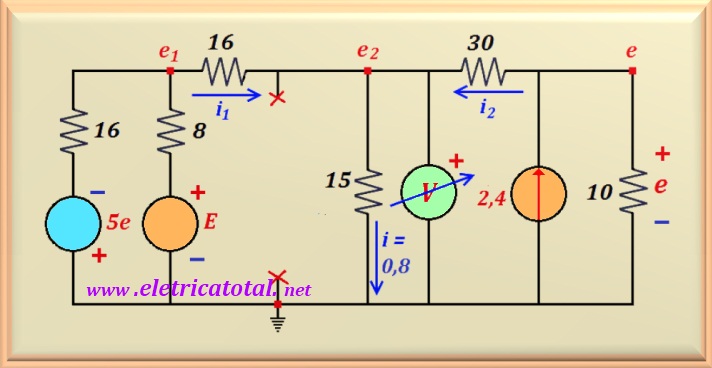
In the circuit below, it is known that the voltmeter V indicates 12 volts.
Calculate:
a) the voltage e;
b) the value of the independent source E.
Figure 12-11.1
Solution of the Problem 12-11
Item a
Since the voltage measured by the voltmeter is 12 volts, then the current
i is equal to:
i = 12 / 15 = 0.8 A
Note two consequences: if the voltmeter measures 12 volts, then no current will flow
through
the 6 Ω resistor that is in series with the
12 volts voltage source, since the potential
difference across this resistor is zero. This implies
that these components can be eliminated
from the circuit without
prejudice to the calculations. Thus, the current source equal to 3 i
acquires the value of a
current source of 2.4 A. Let's redraw the circuit,
simplifying it as
much as possible. See the Figura 12-11.2.
Figure 12-11.2
We know that e2 = 12 volts, since this is the same value measured by the voltmeter.
Let us remember that an ideal voltmeter has infinite internal resistance, so
no electric current flows through it.
Remembering that currents that leave the node
are considered positive and currents that
arrive at the node are considered
negative, we can write the equation for the node e. So:
(e - e2) / 30 + e / 10 - 2.4 = 0
Since we know that e2 = 12 volts, we can calculate the value of e
by simply
substituting the value of e2 into the equation above. Therefore:
e = 21 volts
Item b
Knowing e, one can easily calculate the value of i2, since:
i2 = ( e - e2 ) /30 = ( 21 - 12 ) / 30 = 0.3 A
And knowing the current i2, we can calculate i1, since
from the circuit we have:
i1 = i - i2⇒ i1 = 0.8 - 0.3 = 0.5 A
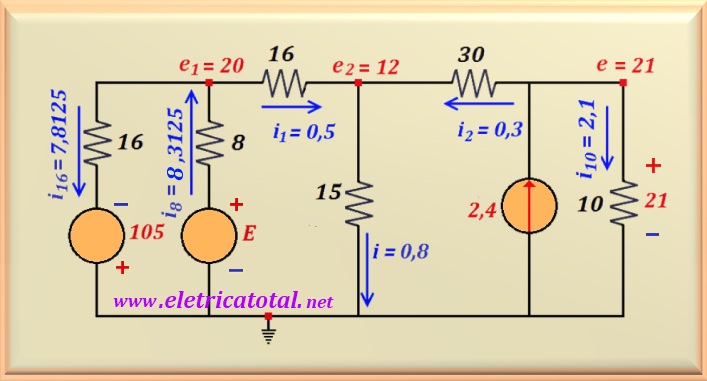
See for the redesigned circuit with the values of the currents
flowing through it.
Figura 12-11.3
Knowing i1, one can calculate e1, or:
e1 = 16 i1 + e2 = 16 x 0.5 + 12 = 20 V
Now, we can calculate the current flowing through the voltage source of 105 volts and
through the resistor of 16 Ω.
i16 = (105 + e1) / 16 = 7.8125 A
Finally, by calculating the current flowing through the voltage source E and the
resistor
of 8 Ω, it is possible to calculate the value of E.