Problema 11-17 Source:
Adapted Question 2 - Electrical Circuits Test -
Computer Engineering
- UFRGS - 2016.
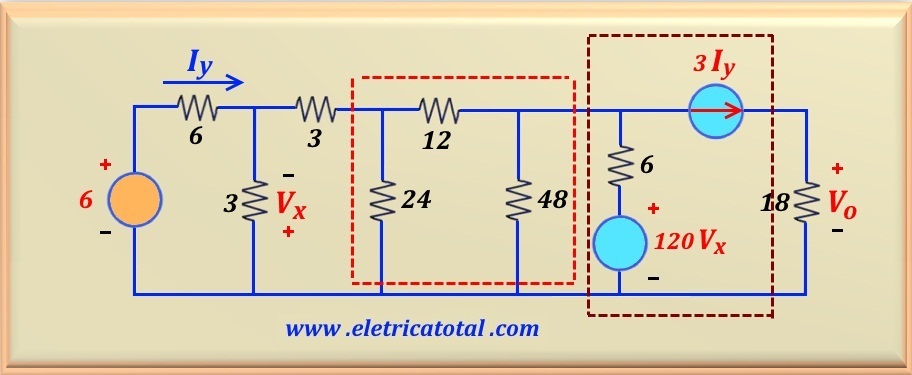
In the circuit shown in Figure 11-17.1, find the values of Iy,
Vx and Vo
Figure 11-17.1
Solution of the Problem 11-17 -
Method of Transforming Sources
Initially, in the circuit shown above, we can perform two transformations: the first, highlighted by the red rectangle,
transforming the
delta circuit into a star circuit; the second, highlighted by the brown rectangle,
combining the sources
into a single one, remembering that the 18 Ω resistor can be eliminated for now,
as it is in series with a current source.
Thus, using eq. 05-01 for the Delta → Star transformation, and combining the sources,
we obtain the circuit
shown in Figure 11-17.2.
Figure 11-17.2
Note that the star circuit, highlighted in the red rectangle, is equivalent to the delta circuit of the initial circuit.
The part of the circuit highlighted in the brown rectangle is equivalent to the sources of the initial circuit,
also highlighted in brown.
To find the value of the dependent source on the right, we must take the branch
highlighted by the green arrow in the circuit above and determine the relationship between
Iy and Vx. Therefore:
-6 + 6 Iy - Vx = 0 ⇒ Vx =
6 Iy - 6
So, the source of 120 Vx, after substituting the value found above, becomes
720 Iy - 720. When we transform it to a current source in parallel with the resistor,
the value of the current source is equal to 120 Iy - 120 (because we divide by the value of the resistor).
From this value, we subtract the source 3 Iy, because it points in the opposite direction.
We find the
value 117 Iy - 120. Once this step is complete, we must return to having a
voltage source in series with a resistor.
To do this, we multiply the value of the current source by the
value of the resistor of 6 Ω, finding the value that appears
in the circuit above, which is equal
to 702 Iy - 720.
Now, in the circuit above, note that the two 6 Ω resistors are in series.
Adding their values together
results in a 12 Ω resistor. We return to a current source with a value of
58.5 Iy - 60.
And the two resistors of 12 Ω are in parallel, resulting in
an equivalent resistor of 6 Ω.
Performing another source transformation, we obtain the circuit of Figure 11-17.3.
Figure 11-17.3
Based on the equation above, it is possible to calculate the current flowing through the resistor
of 3 Ω.
This current is a function of Iy, whose value is 2 Iy - 2,
as indicated in the circuit above.
Therefore, the current flowing through the two resistors of 6 Ω
in series is 3 Iy - 2.
Then, we can write the mesh equation that includes the dependent source. Thus, we have:
-6 + 6 Iy + 12 (3 Iy - 2) + 351 Iy - 360 = 0
Rearranging the equation, we find:
393 Iy = 390
And then, we easily find the value of Iy, or:
Iy = 390 / 393 = 0.992 A
Since we already know the relationship between Iy and Vx, then:
Vx = 6 Iy - 6 = -0.048 volts
And from the initial circuit, we can easily relate Vo and Iy, that is: