Problem 2.21 Source:
Problem developed by the author of the site.
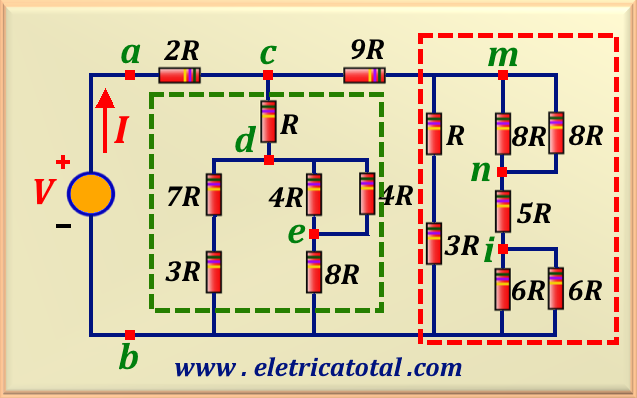
Calculate the value of R in the circuit shown in Figure 02.21.1, knowing that V = 48 V and I = 40 mA.
Solution of the Problem 2.21
To solve this problem, we'll divide the circuit into two blocks, as shown in Figure 02-21.1. We've designated the nodes by letters
for a better understanding of the solution.
First, we'll solve the block highlighted with the red rectangle. Note that between nodes m and n, we have two resistors of 8R
each, in parallel. This results in an equivalent resistance of 4R. And between nodes i and b, we have two resistors of 6R
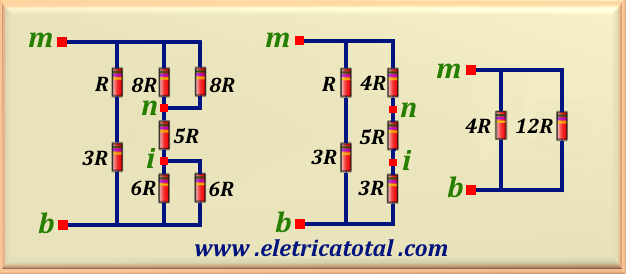
each, in parallel. This results in an equivalent resistance of 3R. Figure 2-21.2 illustrates the step-by-step solution. Thus, we have two branches
with resistors in series. Therefore, simply add their values and find the equivalent resistance of each branch, as shown in the circuit on the right of the figure.
Thus, we have two resistors in parallel: one of 4 R and the other of 12 R. As a result, the equivalent resistance
of the block highlighted in red is:
Following the same reasoning, we can determine the equivalent resistance of the resistor block highlighted in the green rectangle
in the circuit shown in Figure 2-21.1.
Note that the two resistors between nodes d and e are in parallel, resulting in an equivalent resistance of 2 R.
Therefore, we have two branches with resistors in series.
Adding the branch values, we find the equivalent resistance of 10 R in each.
Since these branches are in a parallel configuration, the equivalent resistance is 5 R.
This configuration is also in series with a resistor of R. Therefore,
between nodes c and b, we have an equivalent resistance of 6 R.
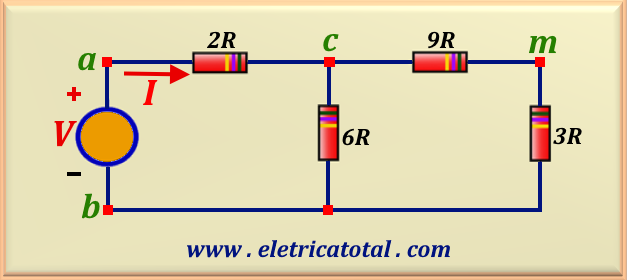
Thus, we can represent the simplified circuit as shown in Figure 2-21.3.
In the circuit shown above, in the branch determined by the path c-m-b,
we have two resistors in series. Thus, this branch has an equivalent resistance of
12 R. And this equivalent resistance is in parallel with the resistor 6 R.
Calculating the equivalent resistance of this parallel, we find 4 R.
Finally, this equivalent resistance is in series with a resistor 2 R, which results
in an equivalent resistance of the entire circuit equal to 6 R.
Thus, we conclude that the entire circuit to the right of the voltage source can be replaced by a resistor with a value of 6 R. However,
the problem provides the value of the voltage source and the corresponding electric current flowing through the circuit. Thus, it is possible to calculate the
equivalent resistance value of the entire circuit using Ohm's law.