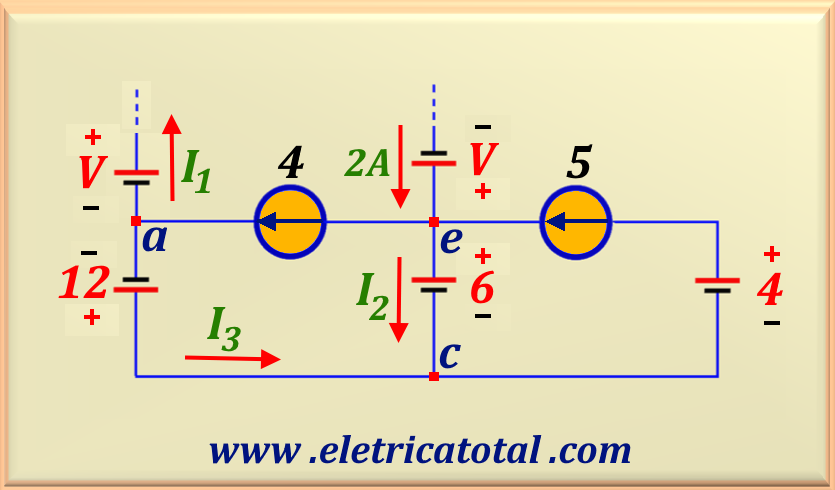
Problem 1.3 Source:
Problem created by the website author.
In the circuit shown in Figure 01-3.1, calculate I1, I2,
I3, and V so that
the law of conservation of energy is satisfied.
Figure 01-3.1
Solution of the Problem 1.3
To solve this problem, it is important to access the chapter on power, by clicking here!
and also the chapter on the law of nodesby clicking here!
Thus, we can begin solving the problem by applying the law of nodes to node e.
- I2 - 4 +5 + 2 = 0
Solving this equation, we find the value of I2, that is:
I2 = 3 A
And applying the same principle to node c, we have:
+ I2 + I3 -5 = 0
Solving this equation, the value of I3 is:
I3 = 2 A
And applying the same principle to node a, we have:
- I1 - I3 +4 = 0
Solving this equation, the value of I1 is:
I1 = 2 A
And to analyze whether the circuit complies with energy conservation, let's calculate the powers supplied and received by the elements.
P12 = 12 I3 = - 24 W
Note that the signal is negative, since the current leaves through the positive pole of the source.
P4 = 18 x 4 = + 72 W
P6 = 6 x 3 = + 18 W
P5 = 5 x 2 = - 10 W
P4V = 4 x 5 = - 20 W
Adding all the powers calculated above, we have:
PT = - 24 + 72 + 18 - 10 - 20 = + 36 W
To meet energy conservation, the two sources symbolized by V must provide - 36 W, therefore:
- 2 x (2 A) x V = - 36 W ⇒ V = 9 V
Therefore, the two voltage sources, V, must have a voltage of 9 V for
the law of conservation of energy to be satisfied, since each source provides a current of 2 A exiting the positive pole.